
The issue of the lack of maintenance at the Vallecas Stadium has a long history and had reached an intolerable state by the start of the 25/26 season. From the fan experience perspective, puddles on the plastic benches, weeds growing in the cement cracks, restrooms without stall doors, and rats in the stands have all, according to La Rayo fan, become 'folk customs,' reminding people that life is always better outside the stadium. In addition, it is well known that if you want to watch a match at Rayo Vallecano, you need to plan at least a two-day trip: one day to buy tickets and one day to watch the game. In 2026, the team still does not have an online ticketing system, has no scalpers, and tickets can only be purchased in person, making it the only team in La Liga in this situation.
If the issue with the stands can still be classified as poor service, then the impact on the competitive level is even more direct. Rayo Vallecano players have repeatedly expressed dissatisfaction with the pitch conditions, saying things like 'not as good as regional leagues' and 'the ball barely rolls,' which are direct quotes from the players. Head coach Iñigo Pérez also felt 'ashamed' of the pitch conditions and sought help publicly, specifically saying 'this is not an attack' to avoid internal punishment. For a professional coach, seeking help publicly about field issues already indicates a failure of internal communication, showing the extent of his desperation.
From the perspective of labor law, when the conditions of the venue continuously affect the quality of training and competition, and may increase the risk of injury, the issue falls within the scope of occupational risk management. Although it has not yet entered formal labor inspection procedures, it already has the significance of occupational safety protection. In this context, Rayo Vallecano players chose to collectively protest through the players' union, precisely because the players felt that internal coordination could no longer resolve the problem and that it was necessary to push the club to respond through formal external mechanisms.
The quality of the turf also influenced the opponent's decisions. For example, Osasuna's Lich immediately decided to adjust tactics upon seeing the condition of the pitch. All the conflicts fully erupted during the cold February match against Oviedo, when the visiting team, unable to take a hot shower, decided to forfeit the game. Subsequently, La Liga initially leaned toward ruling the match a victory for the away team according to the rules. This decision immediately triggered public protests from another relegation rival, Levante, since it would directly impact the relegation situation. As a result, the incident escalated from an internal club issue to a matter involving league regulatory standards and competitive fairness, ultimately affecting the overall image of the league.
La Liga ultimately decided to postpone the match, and this decision was interpreted by some Spanish media as "too lenient," thereby directing criticism toward the league president, Tebas, based on his connections with Presa. The relationship between the two can be traced back to the time of Rayo Vallecano's bankruptcy and restructuring. In 2011, Tebas was the lawyer responsible for preparing all the documents for Rayo Vallecano's bankruptcy proceedings, while Presa took this opportunity to acquire 98.6% of the shares for €961 plus taking on the club's €30 million debt, thereby gaining ownership of the club. Therefore, the historical cooperation between the two is seen by the public not merely as a relationship between a regulator and the club management, and public opinion naturally interprets La Liga's handling of the situation through this existing network of relationships, raising doubts about the fairness of league oversight.
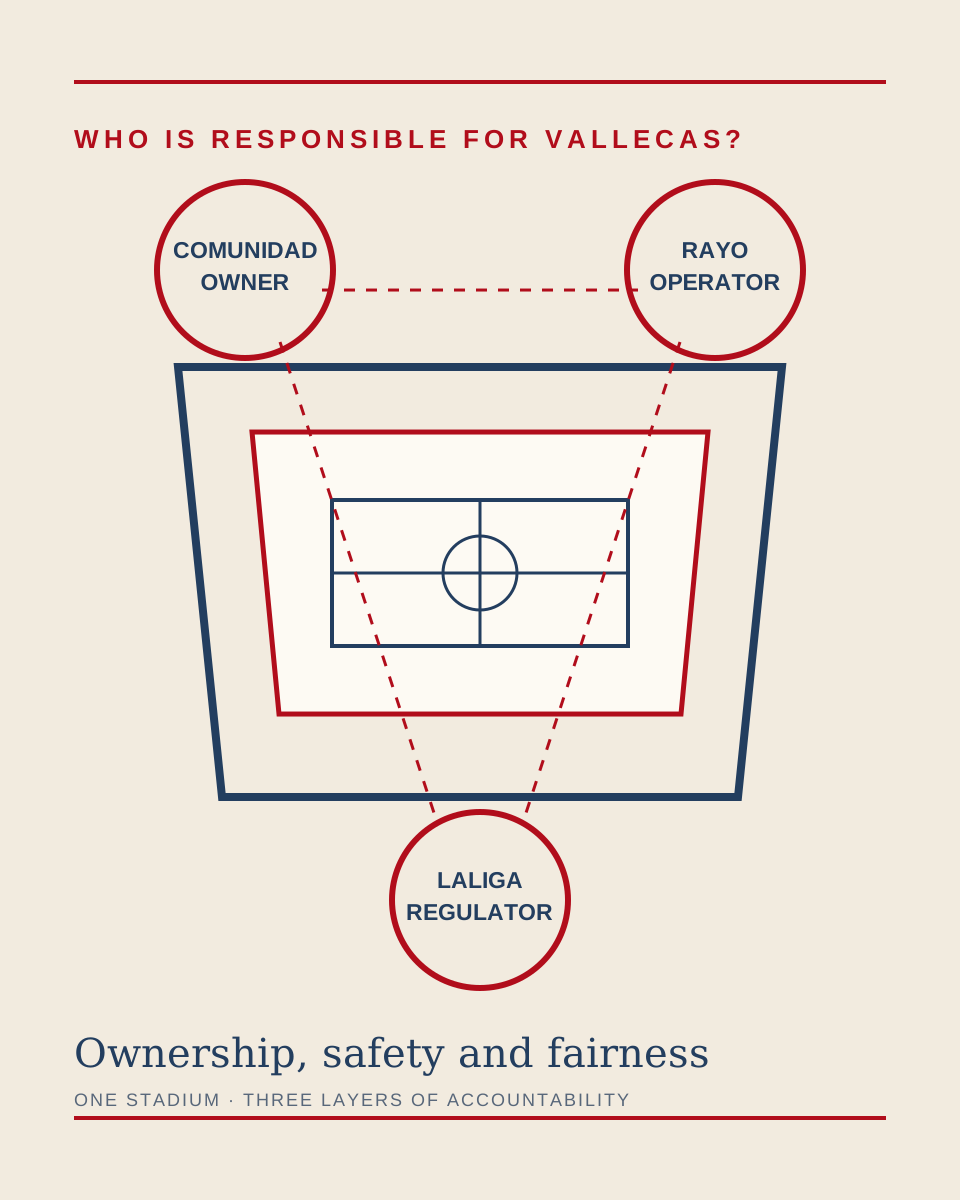
The problem has existed for a long time and is often influenced by multiple mechanisms. In the case of the Vallecas Stadium, it is a struggle between ownership and usage rights. Vallecas Stadium is not an asset owned by the Rayo Vallecano club but by the Community of Madrid. The club obtains usage rights through an administrative concession agreement, which currently lasts for 20 years and includes a renewal clause. This property structure means that any major structural renovation requires the user to negotiate with the owner regarding the term, investment returns, and urban planning coordination. Naturally, when the positions of the two sides differ, there will be a tug-of-war of interests.
In addition, from the perspective of asset allocation and capital recovery, a 20-year usage right period is relatively short compared to the return cycle of heavy-asset infrastructure investments. In asset classes like sports stadiums, which have high fixed costs and low liquidity, the typical investment payback period often starts at 30 years, which is why the concession periods for many municipal stadiums in Spain usually exceed 40 years. Under a 20-year ownership structure, Rayo Vallecano would be very conservative in making major capital expenditure decisions. It is also understandable that when the club receives CVC funding, it does not immediately invest in infrastructure upgrades and takes a wait-and-see approach for the time being.
There are not many clubs in Spain that truly own their stadiums completely; many teams also operate in municipal stadiums. Many clubs also hold short-term contracts of 20 years. Facing CVC's investment requirements, many clubs first negotiate with the local government to extend the term, align with the investment return cycle, and then initiate upgrade plans. Regarding ownership and term issues, Presa's strategy in negotiations is understandable. Whether it is by emphasizing the current stadium's deficiencies, lowering operational standards, or promoting the construction of a new stadium, these are all common negotiating tactics.
But negotiations are not unilateral actions. As the stadium owner, the Madrid community is responsible for infrastructure upgrade planning and needs to prioritize public budgets. But in Spain, delays in lease negotiations due to political costs, financial pressures, or urban planning constraints are also common. Therefore, the current situation of Rayo Vallecas is not solely the club's responsibility.
Rayo Vallecano's luck lies in the fact that the athletic department has indeed gathered a group of highly capable and executed professionals. From transfer decisions and tactical organization of the coaching staff to internal cohesion in the dressing room, their professionalism has long exceeded the club's overall operational level. In recent seasons, despite limited resources, the team has repeatedly performed beyond expectations, with results supporting the club's foundation.
But the stadium's condition reflects the true operational state. Whether it's budget allocation, maintenance processes, internal communication, or coordination with owners, all reveal chaotic and inefficient management. Athletic results can serve as a fig leaf, but they cannot replace organizational building. Once results decline and the deep conflicts between management and operations remain unresolved, the club has almost no buffer space