
A coach like Mendilibar who has gone through hundreds of battles and won consecutive UEFA Champions League titles with Europa League is qualified to say whatever he wants on any occasion. It just so happens that he loves to tell the truth. As juniors, what we should do is to sit upright in front of him, listen attentively to the seniors sharing their insights and experiences, and think about how to improve ourselves.
At the end of June this year, Mendiliba was interviewed for more than an hour by the Basque local media dotb Durangaldeko. He said this in the interview:
"Nowadays, coaches of my age seem to be out of touch with the times. Then there is Sevilla, a great club that relies on data and new technology. I am not against it, I support the football of the past. It seems that the things that were done in the past are useless now. Data, videos, how many steps you ran, how many steps you did not run. Do I like what you did? Don't watch this anymore. Now look at you recovering 34 goals; But if the ball you pass does nothing, what does it mean to me? Or the action of grabbing the ball is actually the effort of the teammate, not the ball grabber himself. No one cares about feeling anymore; I live by feeling, not by the 13 kilometers he ran and the 8 steals he made. The three European champions this year, Gasperini, Ancelotti, and me... I'll leave it at that. Now, if you don't have a drone to record the training, you are an idiot. Football is a sport (el fútbol es movimiento), not a stop-start (para, para, para, para)。Not everything can be controlled, football cannot be controlled, football belongs to the players, not the coach。”
Mendilibar hit the nail on the head and pointed out the focus of most current football data analysis. The key to data analysis has never been the comparison itself, but how the comparison, why Compare. But it is these superficial "analyses" that prevent this industry from going further, and the media's fueling and abuse by some coaches (such as Ten Hagby's xG after the double red game on September 1, 24) have exacerbated the situation.
Sadly, such superficial analysis is common in the data departments of many clubs; sadly, there are still many club data analysts who use the model abandoned by Mendilibar to provide so-called "insights" that ignore context; sadly, many "analysts" do not necessarily even understand the definitions, uses and limitations of these basic indicators, and just use "comparison" to guide the country.
Such an analysis cannot convince knowledgeable fans, but how can it convince the vast majority of coaches who can coach in top leagues and have real knowledge?
Difficulties faced by the football data analysis industry
Since Opta began to provide football event data in the five major leagues in 2007, and in 2019, the player trajectory data provided by Second Spectrum began to be shared within Premier League. The football data analysis industry has only started in the wilderness for more than ten years.
However, the club has expensive and closed data sources (player tracking, skeleton tracking, etc.) but does not have enough and qualified human resources to process them; the top leaders in football data analysis academic circles and data vendors have great achievements in analysis. In terms of application, they are obsessed with the dream of AI. Although the starting point is not bad, the inexplicability of the black box model, coupled with the nature of football as a chaotic system, chaos plus chaos, is destined to make the information generated by these AI analysis models appear to be of limited value in front of any responsible sporting director, reducing it to empty talk.
In addition, the opposition between data flow and traditional genres triggered by the movie "Moneyball" (let's not talk about the difference between football and baseball here) has made the relationship between data analysts and the team's scouts, sports scientists and even coaches delicate. As a serving department, the data department's job is to provide support for other departments in football operations, rather than the relationship between who replaces whom. This dichotomy also doesn’t help the club’s data scientists understand the football questions that really need to be answered.
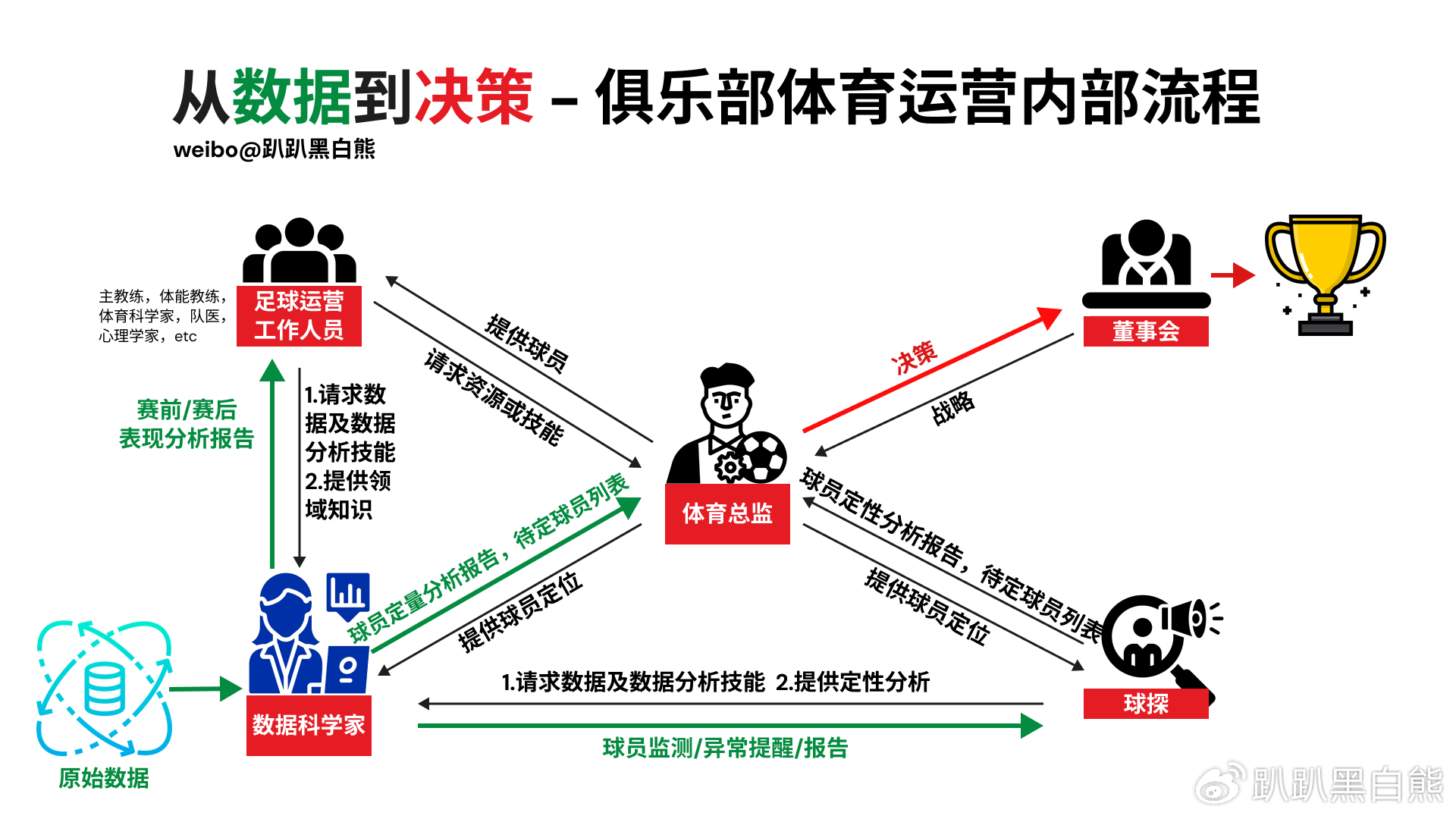
The picture below is the "data-assisted sports management" process summarized by the author after communicating with some clubs. I personally prefer to use the term "data-assisted" rather than "data-driven" here because what drives the club is always a decision-making based on football operations, not the data itself. You cannot put the cart before the horse.
The limitations of data sources, the development path of industry leaders and internal governance issues of clubs are undoubtedly the difficulties that the entire football data analysis industry is stuck in. Everyone who has seen player trajectory tracking and skeletal-tracking data knows the value contained in it. Therefore, this type of data is expensive and difficult to obtain. Clubs are unwilling to share it easily even if they do not have the resources and ability to process it. However, this is the starting point for football data to be barely considered "big data".
If player trajectory tracking and skeletal-tracking data can become as popular as event data is today, allowing anyone with data analysis or modeling skills and understanding of football to try various possibilities, perhaps the entire industry can move forward. With the explosion of computer vision technology, there are already companies that can come up with relatively mature solutions. Although there is a huge gap in the quality of data collected by video extraction and on-field sensors, and there is considerable technical difficulty in supplementing the prediction of player trajectories outside of broadcast videos, it is enough to be an excellent tool to assist sporting director decision-making.
The crux of the football data analysis industry
But these difficulties are not the crux of football data analysis itself. But before talking about this issue, please allow me to talk about a story that has nothing to do with football, because this is the key to understanding this issue.
In the past ten years of my career in the UK, most of the author has spent in large consulting companies and national-level infrastructure management companies, mainly involved in projects related to airports, railways, water affairs and urban planning. He is affiliated with the Business Intelligence (Business Intelligence, including strategic consulting, asset management and B2B sales) department, and the Data & Decision Science team.
In these traditional fields, relying on the accumulation and iteration of data for several years or even decades, relying on accumulated business experience of decades or even hundreds of years, relying on countless research and use cases accumulated by national-level investments, data scientists can have a very in-depth understanding of business and customer needs, know how to use data to accurately characterize specific business problems, and know what models should be used to answer what questions.
I have seen data on the condition of British train tunnels dating back more than a hundred years (yes, the tunnel outside Liverpool Lime Street Station), modeled the problem of tunnel aging, and helped customers optimize the distribution of maintenance budgets for railway tunnels across the UK.
I have seen how British Railways caused 3 deaths and 6 injuries in the Stonehaven derailment in 2020, and was fined 6.7 million pounds. After a year and a half of investigation, it was found that the cause of the accident was a failure of the drainage system and design issues near the railway. After that, I participated in the design of a system to monitor the status of the water system along the railway tracks in the UK. Based on factors such as geology, weather, drainage system life and railway load, it predicts possible high-risk accident sections and recommends intervention to prevent such tragedies from happening again.
We have seen the distribution of water supply and sewer pipe networks throughout central England, as well as various operational data accumulated over decades, and then made investment plans for the next 25 years for customers. In hundreds of different scenarios, different investment portfolios were selected according to actual conditions to improve the quality of water supply services in the region in the most cost-effective way, thereby helping customers pass the evaluation of Ofwat, the British water regulatory agency.
Even in such a field where data assists complex decision-making, the effect of AI predictive analysis models is not ideal except for individual problems (recommendation systems, image/video recognition and tracking, large text models). AI-based predictive use cases are not only about Explainability There are inherent flaws in it, making it difficult to deliver to customers; even if the issue of interpretability is ignored, the effect is difficult to achieve expectations. One-pass operations are not as good as linear regression, which is commonplace. How much computing resources are burned has to be calculated separately. So when we talk about AI, it's not so much a technology issue as it is a sales issue.But the core work of the business intelligence team still lies in business analysis. In addition to predictive analytics, the need for descriptive analytics and business monitoring is very important for any organization today. Whether a company can operate properly has nothing to do with how many bowls of noodles an employee A has eaten today (probably), but is closely related to whether the company understands a specific business, the corresponding strategies, tactics and operations of the company and even the industry at different stages and with different resource allocation conditions.
In the world of football, especially in terms of football game analysis, the "business analysis" part of the traditional industry has been skipped. Many analyzes stop at the level of "how many bowls of noodles have been eaten" rather than going to Understand deeply what happens on the field and the needs of the coaching staff, and then describe the indicators that data scientists need from a football perspective. Use football language instead of data language to code and describe as much data as possible, and translate football into data.
In traditional industries, minor demand changes sent by customers every day are commonplace. Customers can conduct half-day or even several-day workshops with data scientists to determine specific needs, determine how to translate company or organizational strategies into data models step by step, and determine whether the quality of customer data is adequate. Defects, how to formulate data governance plans, how to establish data pipelines, how to create new indicators to describe the business, how to set up different business scenarios... Whether it is customers or colleagues, people ask me to make changes every day, asking me to do better in each project or even the entire project portfolio management, Looking for better evaluation criteria, looking for something that can be explained more clearly in business。But what about in the world of football? The items captured by Opta's event data, as well as the quality of capture, have not been improved for how many years because of the lack of competitors in the industry? After the ambiguous definitions of Dribble and Duel were pointed out, are there any further improvements to Wyscout/Hudl/Opta? Are analysts satisfied with highly subjective smart passes? Are you satisfied with the number of shots in a game? Are you satisfied with the number of passes per 90 minutes? Are you satisfied with the number of crosses based on Possession? Are you satisfied with a VAEP that is deliberately stacked with formulas, overly complex, and has no practicality at the event data level? Are you satisfied with a flashy passmap that lacks context? Are you content with throwing tracking data into a neural network that you don’t understand at all, and then drawing some specious conclusions?Sadly, in the past ten years, the football data analysis industry has been content with this,Although this is a necessary stage for the development of a new industry. Except for a few (probably no more than 5 in Europe) qualified clubs that can produce their own or purchase third-party indicators to support relatively high-quality analysis, for most clubs, the data department is nothing more than following the trend, or it is established because of the requirements of league policies (such as La LigaCVC). It starts out as absurd and ends up as false. The event data supplier is happy to make money, and naturally has no motivation to improve data quality (but based on the industry standards set by FIFA, the quality of tracking data is relatively high, which is a good thing).
Descriptive analysis reports on players written without any awareness of the limitations and subjective biases in the data are rampant. In order to appear superior and "understand analysis", fake indicators produced by formula models are rampant. This is not only destroying the industry, but how can it provide actionable and valuable information to players, scouts, coaches and sporting director? How is it possible to gain the trust of stakeholders? How is it possible to build a true data culture?
This is a war we are losing.
Looking at the major football data summits in the past few years, except for some computer vision-related research that is practical, they are basically dominated by derivatives of so-called AI, LLM, Possession Based models, and VAEP, talking about how to predict the future. But for the football data analysis industry, before blindly investing in complex AI projects and burning the salaries of several first-team players, it is more important to at least do descriptive analysis first. At least we can explain the current information pragmatically, and then we can discuss whether we can predict the future. Starting from the complexity, chaos and unpredictability of football, let us at least explain what is controllable on the field. It is not until we don't know what else can be explained by existing events, tracking, skeletal, GPS tracking and various performance data held within the club that it is time to move forward to modeling.
What can football data analysis do?
Reality is never so black and white, don't be led by difficulties and empty talk.
Mendilibar, who loves to tell the truth, won the Europa League championship but was kicked out by Victor Otra. This is the tragedy of Sevilla, and the right and wrong are beyond the scope of this article. But as a football data analyst, how can I do better when recommending a player to Mendilibar? When I explain to Mendilibar what happened in a game, what information is useful to him and can actually be used to improve the team's performance?
When sporting director or the coach asks for a player, they often give specific characteristics corresponding to the desired role. These characteristic descriptions are often not too long. In the process of transmitting information, due to everyone's different understanding of football, there will also be losses or deviations. In addition, there are limitations in the current common indicators, making it is impossible to completely re-create the role of the player that is exactly the same as sporting director or the coach's understanding.
Therefore, when communicating with a sporting director or coach, analysts must first "visualize" these characteristics, whether in the form of a data chart or video. In principle, choose the visualization method based on sporting director or what the coach is more accustomed to. If the diagram is enough to solve the problem, then use the diagram. If it will be clearer to explain it with a video, then use the video. The key is to confirm that your understanding of the players is as close as possible through communication Their request.
For example, the common No. 9 in Spanish football can often catch the ball near the center of the outer third of the offensive zone, then split the ball and rush forward, and then catch the ball again in the penalty area (see Oyarzabal's goal in the European Championship final). If sporting director or the coach wants such a player, after watching the video, we should be prepared to ask or answer these questions:
- How did Oyarzabal get to the starting position in the picture? Running without the ball or advancing with the ball?
- Where did the ball come from to Oyarzabal?
- How long did it take for Oyarzabal to pass the ball to Cucurella? A kick after catching the ball? Or is there any adjustment? How long did it take to adjust?
- What's his side speed?
- How much pressure did the English players put on Oyarzabal when he received the ball?
- After Oyarzabal passed the ball, did he run on the blind side of the penalty area? How to run?
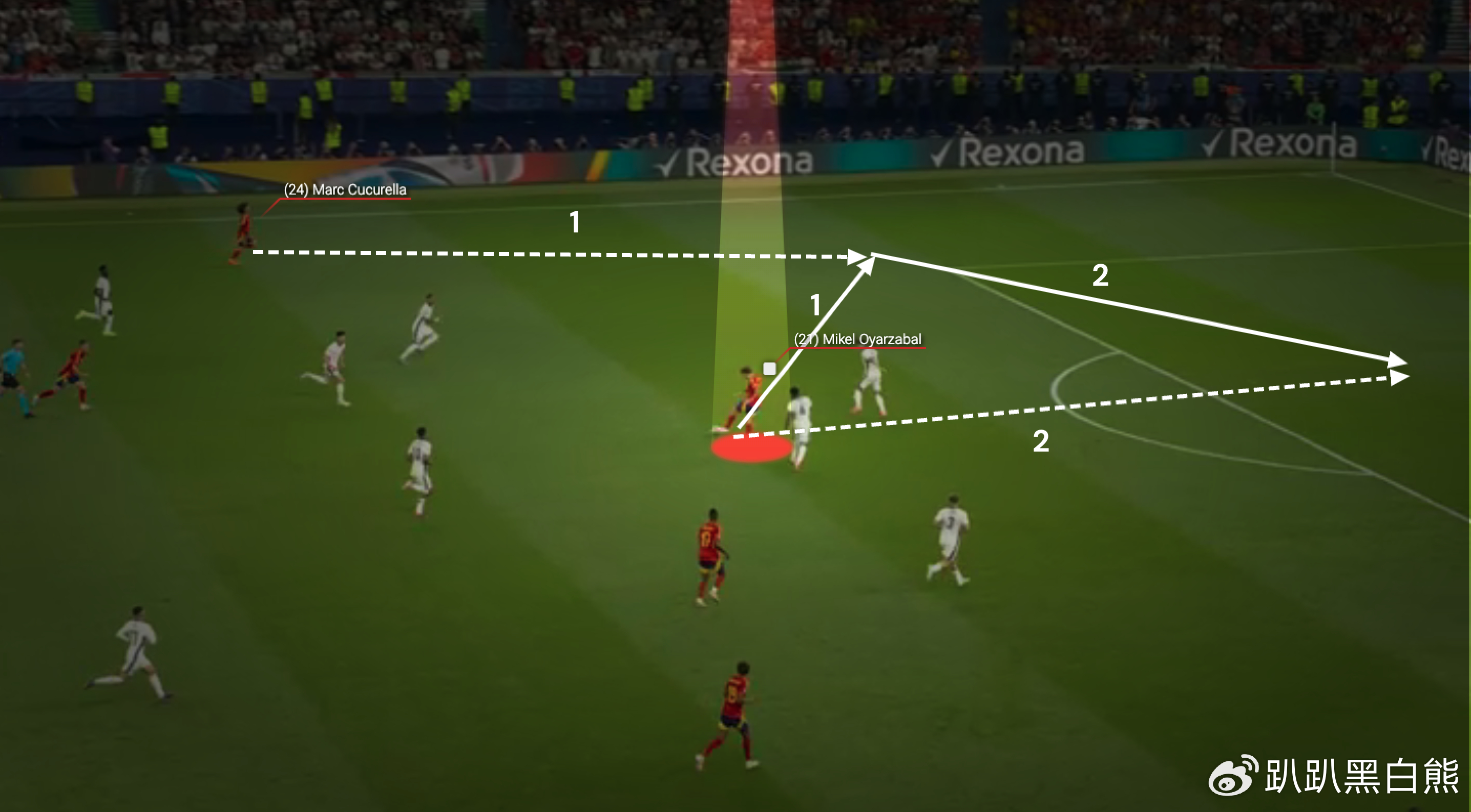
The arrows in the picture above can already see the scene of hitting the wall and the corresponding ball path, and using data to describe the location, time, position, ball speed, position and relative distance of the defender, and the size of the space near the receiver through data, Translate football into the data as much as possible, which is currently possible. Going a step further, if skeleton data can be applied on a large scale, not to mention complex posture problems and biomechanical problems, it can at least solve the problem of the orientation of the player's head and body, as well as the problem of whether there is confrontation and the type of confrontation, and then add more valuable details to the description of this scene.
As Mendilibar said, football is uncontrollable. Therefore, when describing the scene, it is also necessary to add the "fuzzy" part. It is necessary to consider more "possible" situations in similar scenes, and add different conditions to describe different scenarios respectively, and classify them well.
After we can use data to describe this type of scenario, we can find out in the historical records which leagues and which players have completed this type of scenario. Compared with traditional indicators such as passing accuracy or passes into the penalty area, scenario-based definition is a feasible practical method for translating football into data in scouting work.
Of course, there are players who have the ability to complete the above scenario, but due to various reasons (see Casemiro who was trapped in a pressure trap and lacked a receiving point to play the ball, although he is not No. 9 and the corresponding ball path is different, but the principle is the same) cannot be seen in the data (obviously impossible in the video), can we, as Mendilibar said, "feel" that it is possible for him to do it?
Of course not. But what we have to solve now is the problem of descriptive analysis. We can use the same scene that happened in the past as evidence to show which players participated in executing this scene and who executed it when playing, instead of just guessing like water without a source.
Combining player trajectories and event data, which have basically been popularized in the five major leagues, in terms of scouting and performance analysis -
- Can we know whether an action is a pressing action, who performed the action, and whether the action helped our team regain the ball? Can
- Can we know whether a pass in a partial passing match creates an advantageous situation for the team? Can
- Can we know whether a run without the ball resulted in a breach of defense? Or create space for teammates to provide containment? Can
- Can we know whether a midfielder's retreat with the ball relieves the pressure on the defense and opens up space for the wide players to advance? Yes
- Can we know whether a midfielder's lateral separation has the effect of attracting the opponent to the strong side and opening up space for a subsequent quick move to the weak side? Can
- Can we know that when facing a low defense, whether our passing team is completed at a certain speed and occupies the corresponding space? Yes
- Can we know that, after successfully containing the opponent's centre-backs and stretching the full-backs, can we exploit the space between the opponent's defensive line and the midfield? Yes
- Can we know whether, during the build-up phase, the goalkeeper successfully passed the ball to a player who was some distance away and had some space, and whether the pass was completed in a sequence that drew the opponent to the weak side? Can
- ………………
- Can we analyze how a player feels? Can't, but we can try to change Get close to the question to be answered, and measure it as much as possible Measurement to assist decision-making.Just because you don’t know how to use the data doesn’t mean the data is useless. Beyond the scene description method, there are other ways to translate football into data. The iteration of the methodology is inseparable from communication and cooperation with scouts, coaches and sporting director, specific football issues and scenarios, the construction of data pipelines, and the desire to explore analysts who are dissatisfied with the status quo.
The "feeling" method itself is also an effective way for Mendilibar to integrate a large amount of information to make judgments in an instant through decades of experience accumulation, and most excellent decision-makers often have good intuition. If a club can afford 100 Mendilibar, which can cover tens of thousands of players in hundreds of different leagues in hundreds of countries around the world, then it can directly rely on "feeling" within half an hour of sporting director or the board of directors' request. Recommend the strongest players with added value who are most in line with the current coach's style of play, the club's financial situation, the current league rules and regulatory mechanisms, and ensure that his recommendations are correct, then all football data companies can delete their databases and dissolve them on the spot.
Because it is impossible, because there are too many bastard scouts, and because of the complex interest chain of agents, player recruitment has become the first application occasion for football data analysis. Clubs such as Liverpool, which have been involved in the game for many years, have accumulated a large amount of research and have the ability to mine tactical trends and tactical suggestions from tracking and performance data to provide coaches with meaningful insights.
Perhaps, if there is a chance, when I use data to recommend players to Mendilibar, or use data to describe a specific scene of a certain game, he will probably hate everything I want to show, or even tell me to get out. But not everyone is content with doing football data analysis in such a superficial and sad way, as he mentioned.
At least, after the author has dealt with some sporting director and coaches, they gradually began to look at the data in a different light.