
Generally, I rarely make premature conclusions about people or things, preferring to evaluate their usability and evolution possibilities. However, Rosenier will be dismissed due to loss of control in the locker room, and even ClearlakeChelsea's "asset management" are sufficient signs at a very early stage, showing that his plan lacks logical and structural support. For those with experience in coaching, asset management, and club operations, it is not difficult to identify it at all levels.
Today, the "Clearlake model" alarm bells are ringing. If the public financial information and the current regulatory framework are combined, a judgment can be formed:
Once Chelsea cannot participate in Champions League next season, in the next 2 to 3 years, from 22 HoldCo, BlueCo 22 and the entire organization built by the Chelsea club, the operating space of this complex leverage model that is highly dependent on debt financing and valuation growth expectations will be significantly narrowed. After that, investors will be forced to accept huge losses and exit early.
For Chelsea fans, it can be a little comforting that the so-called exit (exit) actually means that BlueCo, the entity that bears the debt, must sell the club to fulfill its debt obligations. Fortunately, since Manchester United, the UK has strictly restricted the acquisition of clubs by investors, and does not allow the debts generated by the acquisition to be placed on the clubs themselves. Therefore, Chelsea Club itself is not in danger of bankruptcy. Investment losses will be borne by the private equity investors at the controlling level.
Whether the "Clearlake model" can run through, there are mainly the following two core constraints:
The first is supervision. Under the increasingly strict regulations of UEFA and Premier League, it has been difficult for the club to directly cover the team's losses through the owner's own pocket. This is IFR After the establishment of the Independent Football Regulator, fans and owners have a mindset that needs to be changed.
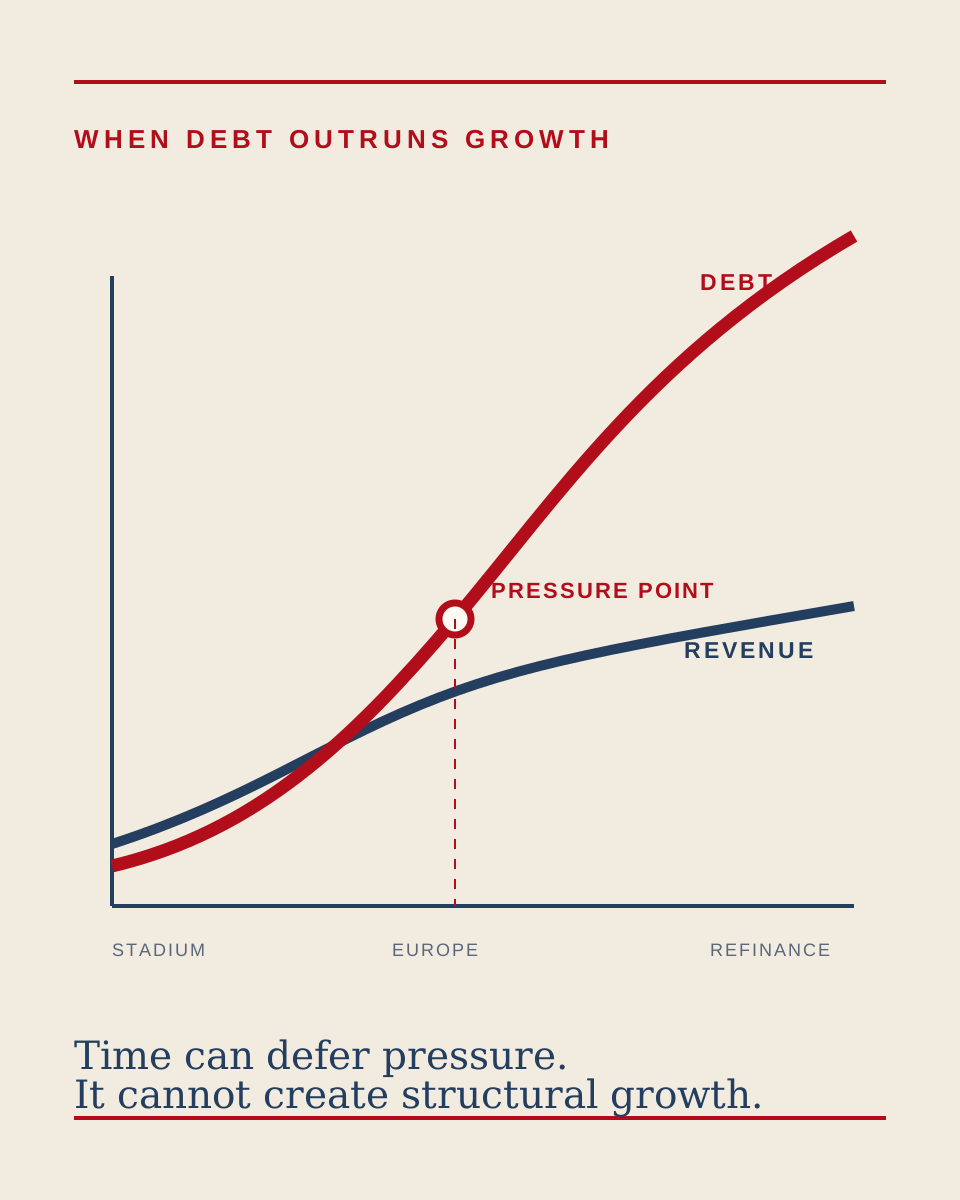
The second is revenue growth. Chelsea has structural revenue growth difficulties. Once Champions League continues to be absent, it will be more difficult to support the valuation through revenue growth. Once the valuation growth cannot exceed the debt rollover, the capital can only sell in advance to recover funds as much as possible.
IFR's entry into the game means that the boss can no longer freely scatter coins, which is easy to understand. To explain the structural difficulties in revenue growth, let us first go back to 2022 and see how Chelsea was sold by the British government.
At that time, the British government sanctioned Abramovich in the name of the Russia-Ukraine war, took over the Chelsea club from Abramovich, sold the club for 2.5 billion pounds on his behalf, and then put the funds obtained from the sale of the club into a trust fund to freeze. The original intention was to distribute the money to the victims of the Russia-Ukraine war. At the same time, The British government also requires buyers to commit to investing an additional £1.75 billion, which will mostly consist of investor-led loans.
Investors usually believe that regardless of any industry, particularly large amounts of mandatory investment will mostly be used for Capex (capital expenditure), thereby settling into club assets, bringing higher revenue, and thus obtaining returns. For Chelsea, the most ideal path at that time was to allocate at least 1 billion pounds to build a modern stadium and turn it into club assets, thereby fundamentally improving the club's revenue structure. The new stadium will not only bring higher ticket revenue on game days, but also bring more diversified commercial development cash flow in the form of a complex.
If the new stadium plan is promoted, it will be of great benefit to the valuation growth of Chelsea. After the completion of Tottenham's new White Hart Lane, the valuation soared from 1 billion to 1.5 billion pounds to 2.5 to 3.5 billion pounds. But the challenges faced by the new stadium are manifold. Different from the dilapidated Tottenham in District 3 of North London at that time, District 2 of West London where Chelsea is located is a prime location. Land has always been given priority to residential and commercial real estate. The demolition of many historical buildings is costly and time-consuming, so negotiation and approval are objectively difficult. There are also difficulties in negotiation whether the CPO (Chelsea Pitch Owner) agrees to the relocation of the Chelsea club. However, no matter how difficult it is, if special funds are reserved for the new stadium, the plan is substantially advanced, and even if it only starts construction in the next four to five years, it can bring definite growth expectations to Chelsea, then the "Clearlake model" can be run through.
Regrettably, Four years later, Clearlake squandered about 1.5 billion pounds on transfers, salaries and agent commissions, of which salary and commissions are typical operating expenses (Opex), while transfer fees are counted as depreciable intangible assets in accounting, and are amortized through the ultra-long contract period and included in the cost year by year. However, compared with infrastructure investment that can continue to generate stable cash flow, the economic nature of player contracts, which is the club's right to the player's future competitive performance, is significantly uncertain. A large amount of capital is deployed in assets that rely on performance rather than in restructuring the income base. Investors made a big mistake in asset allocation, which directly caused the Chelsea club’s revenue structure to stand still. Because of this, CVC has set strict restrictions on the use of club funds in its investment in La Liga and Segunda División. Most of the funds must be used for stadium, infrastructure and business capacity construction, and only 15% is allowed to flow to the competitive level.
The revenue generated by Stamford Bridge itself is much less than that of modern stadiums such as Liverpool, Arsenal, Manchester United and Tottenham.
In the past 25 years, there has been a gap in most years between the extremely high competitive costs brought about by the Chelsea's wealthy positioning and the actual revenue capabilities limited by the capacity of the Stamford Bridge. Take Tottenham, whose total revenue is similar, as an example, match day revenue in 2024/25, Tottenham is about 150 million euros, while Chelsea is about 103 million euros. This gap of nearly 50 million pounds was filled in the past through the net profits from the sale of Cobham’s high-quality youth training, Abramovich’s interest-free loans, and Clearlake’s loan system. In other words, If Chelsea wants to compete with other Big X giants, in most years, some entity must invest at least tens of millions of pounds to make up the gap.
In 2025, due to winning the Club World Cup, Chelsea can fill the gap with a one-time huge bonus of about 70 million pounds, but this is a non-recurring benefit that comes once every four years. The problem is that once Chelsea cannot play Champions League next season, this structural deficit of tens of millions of pounds will resurface. When the risk of Chelsea not being able to play Champions League next season gradually increases, due to The settlement agreement with UEFA), regulators have become more and more serious about Chelseacase.
In other words, from an economic perspective, they originally achieved the requirements they negotiated with UEFA this season, but now due to competitive reasons, they cannot play Champions League next season, resulting in losses of tens of millions of pounds. The result is that Champions League cannot be played in the next season due to competitive reasons, and Champions League cannot be played in the next season due to economic reasons. The losses continue to expand. In the end, Chelsea will not only be restricted in UEFA, but will also be suppressed by the new spending restrictions of Premier League.
Without a new stadium, there will be no endogenous cash flow growth. Without cash flow growth, high-interest debt cannot be covered. Without the European war, it will be even worse. This is the so-called structural revenue growth problem. Of course, in the next two or three years, as an asset management giant, Clearlake will be able to extend the buffer space by liquidating player assets, refinancing, adjusting the amortization structure, debt restructuring, etc., as long as Chelsea's player asset package can maintain balance on the books, which is the so-called "stress test." However, these methods all come at a high cost. They essentially trade time for space, rather than fundamentally solving the problem In the "Clearlake model", the stadium construction lags behind and cannot meet the debt deadline.
Therefore, from the perspective of the operating cycle of private equity, Clearlake Capital’s actual exit window has entered a countdown, roughly within the next 4 to 5 years, after all, for limited partners, the limit of patience for listening to Clearlake explain the rationality of locking up funds is 8 to 9 years.
The real mandatory constraints come from the debt structure, that is Under the existing agreement, Clearlake will withdraw no later than August 2033, which is the maturity node of Ares Management's high-interest PIK loan that can ultimately reach 1 billion pounds.
Ares Management This PIK loan is very complex and will not be elaborated here. A simple understanding is that the principal is about 500 million pounds, and the comprehensive annual interest is about 10%. However, since the interest will be directly calculated back to the principal, the final repayment amount may exceed the principal and interest of 1 billion pounds, and it also comes with various rights and interests. As a result, 22 Holdco built an unprecedented and breathtaking high-leverage financial project in European sports based on Ares Management's loans. Once it fails to repay before maturity, Ares Management will be able to seize control of all subsidiaries including BlueCo 22 and Chelsea Football Club from the parent company 22 Holdco in the form of debt-for-equity swap through the equity it holds.
So the question becomes, can Chelsea be sold for more than 1 billion pounds by then? As long as Chelsea can remain in Premier League, the answer is yes, so that the principal and interest of 22 Holdco to Ares Management can be repaid. The question is, how much debt do Clearlake and other investors still have to pay after paying off this money? How much money is left to repay the principal?
As for the final acquisition price, according to the conventional valuation logic of sports assets, the club’s valuation is 3 to 4 times the annual revenue. Chelsea’s current revenue has various calibers, ranging from 550 million to 700 million per year, which means the selling price is about 2 billion. After repaying Ares's principal and interest of about 1 billion pounds, taking into account the original cash consideration of 2.5 billion pounds, there may eventually be a serious investment loss of at least 1.5 billion here alone, which will be borne by the investors themselves and has nothing to do with Chelsea.
Why might the valuation be lower than the original purchase price? Because capital premiums often come from growth expectations. If the "Clearlake model" can run smoothly, there is no need to exit early; once it exits early, it will announce two facts to the market: first, the Clearlake model has failed; second, the new stadium plan has failed and the revenue structure has been solidified. With annual revenue lagging behind Liverpool by about 250 million euros, growth expectations have proven to be limited, and the premium will be limited. Even if the scarcity value of the West London Premier League team is still there, the valuation will return to the cash flow and asset base.
For the new owner, he will take over a club with relatively clean debts, and his first priority is cost control. Refer to Lajue Manchester United to cut expenses. But after that, considering that the stadium expansion plan has been blocked for a long time, at the same time, with the rapid growth in revenue of Aston Villa (€450.2m) and Newcastle (€398.4m), these two clubs are narrowing the revenue gap with Chelsea (€584.1m). In the future, this second echelon may have more Premier League clubs joining at the economic and competitive levels. At the same time, Manchester City (€829.3m), Arsenal (€821.7m), Manchester United (€793.1m) and Liverpool (€836.1m), as the first echelon of Premier League, are already in another higher level, gradually approaching Bayern Munich (€860.6m) and PSG (€837m).
The first echelon is gradually widening the gap, and the second echelon is gradually catching up. After the revenue cannot undergo structural changes, no new growth points can be found, and the boss's money-spending model is blocked by the new regulatory mechanism, I personally have doubts about whether Chelsea can maintain its status as a wealthy company. It is more likely that under the dual squeeze of economy and competition, it will slip into the middle of Premier League. The breaking point is Cobham, which is the future hope of Chelsea.
A team that can design complex holding systems, have endless creativity in financial engineering, and can also play with PSR, from a technical perspective, they are all top experts with undoubted ability. But from a strategic perspective, the more than one billion pounds of tuition fees paid in the past four years is more like paying the cost of path selection.
Technical sophistication cannot conceal strategic arrogance. Investors who hold up leverage and walk a tightrope between loopholes in the rules never seem to figure out where the core growth point of Chelsea as a football club is?