
Atlético This season, with the two nodes of "Betis-UE Vic" and "Celta-Real MadridChampions League two rounds-Barcelona", it can be divided into three stages.
The first stage: the collapse of the three-center-back system
Atlético's offensive system collapsed at the beginning of this season, and the collapse started from the ball-out stage, and it was even difficult to advance to the opponent's half. It also made it impossible for Koke, DePaul, Barrios and Grizi to read the game in the creation stage.
At that time, the team was obsessed with moving laterally from the backcourt, passing back and compressing the distance to gain a sense of security and offensive space. This idea can rely on the formation structure to suppress the opponent in terms of numbers when the ball is played on the first line. But to break the deadlock, asymmetry must be created in the system.
Thomas is good at solving the ball-playing problem alone, and Hermoso is good at solving most of the ball-playing problems. If it is like Inter Milan, there is no problem with two Champions League top four starting forwards to contain the space. But as a result, three central defenders will neither allow Atlético to defend better, nor will it be helpful for advancement. In the past, the left central defender was Hermoso. The significance of the three central defenders system was more to provide protection for him when he moved forward as a midfield organizer. However, after losing Hermoso in Xia Chuang, the three central defenders system lost its meaning.
If there is a problem with advancement, it will be difficult for Atlético to transfer the pressure. In order not to be defeated, Simeone has to adopt a huddle defense mode. The team must maintain a high degree of organization, but the price is that it cannot pull the opponent through displacement to create gaps, thereby breaking the local balance. This pursuit of stability has become a dead end for offense. Atlético can only rely on the two wing-backs to widen the width and play the ball from the wing, but players in other areas rarely cooperate with the movement, and the ball path is often cut off when the second kick is passed. Players who are limited by organization become isolated islands. Once they cannot control the ball, they can only kick the ball forward as far as they can.
Second stage: Fundamentalism Simeoneism
The three central defenders were unable to work. The 4-4-2 and Simeone in the second stage were not achieved overnight. The game against Betis was the first time this season that 4-4-2 was used. The scene was chaotic and brutal. It can be called one of the worst games in recent years.
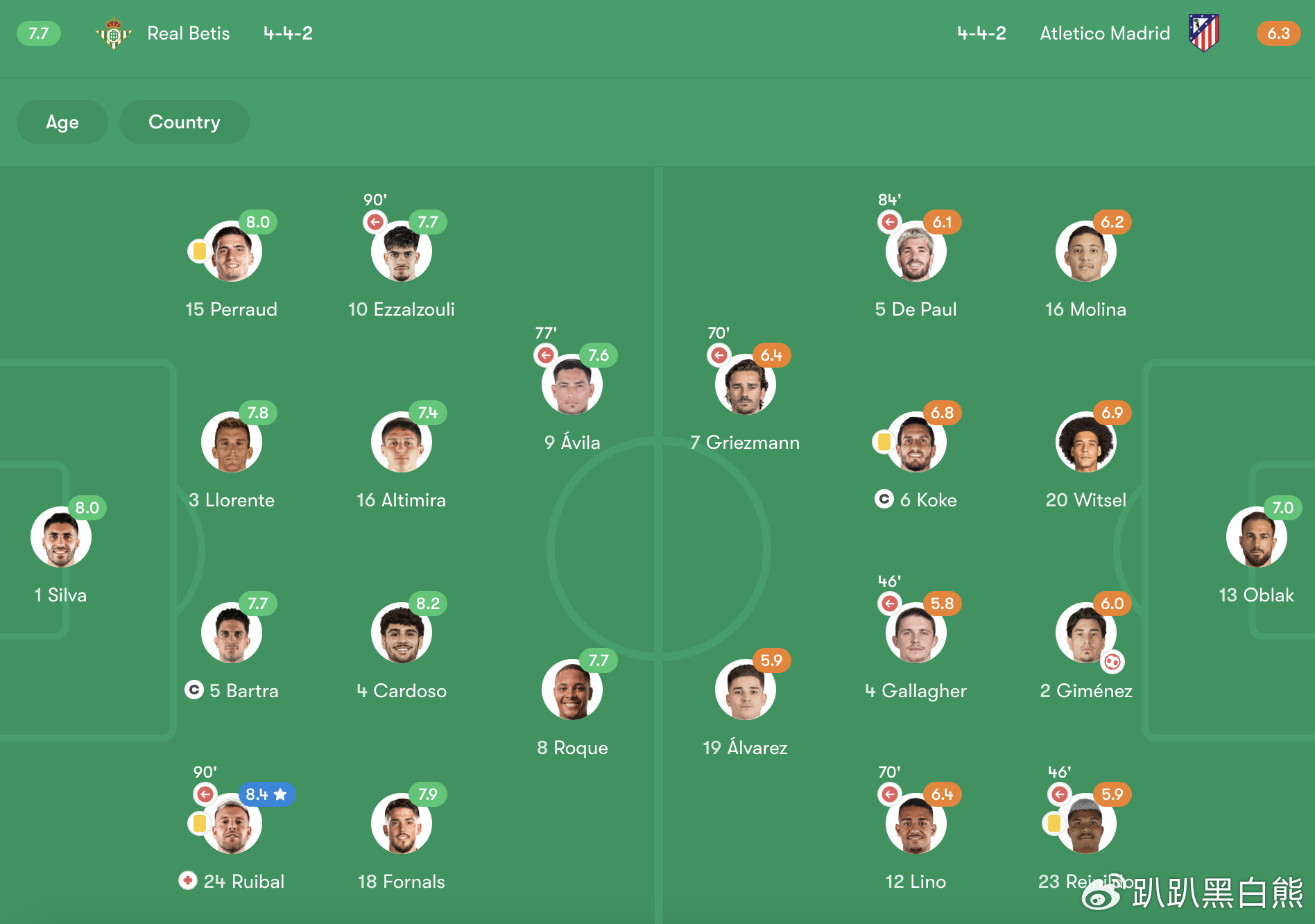
Atlético's worst game this season
This also shows that the formation is just a framework, and what really determines the game is the players, the connection between the players, and the attitude of the team.
Subsequently, Simeone selected those players with strong fighting spirit, strong body and qualified confrontation within the framework of 4-4-2, and regained the Ten Commandments from chaos. This is more reflective of the return to the essence of fundamentalism (Cholisimo) than the appearance of 3-5-2 or 4-4-2.
At this time, he needed a role model player to practice it, so he chose the person closest to him, his own son-Giuliano Simeone, as a proof of belief: using one less defender and one more forward forward playing on the right midfielder. Cholito linked up the front and backcourts, activated the entire right half, became the source of creating asymmetry, and also assumed many tasks of assisting defense and fighting. This is no small thing: Cholo dedicated Cholito to Cholisimo as the most precious lamb. This symbol of blood brings a wonderful metaphor to the reconstruction of the Atlético system this season.
Atlético, who was thought to be dead, became his original self again.
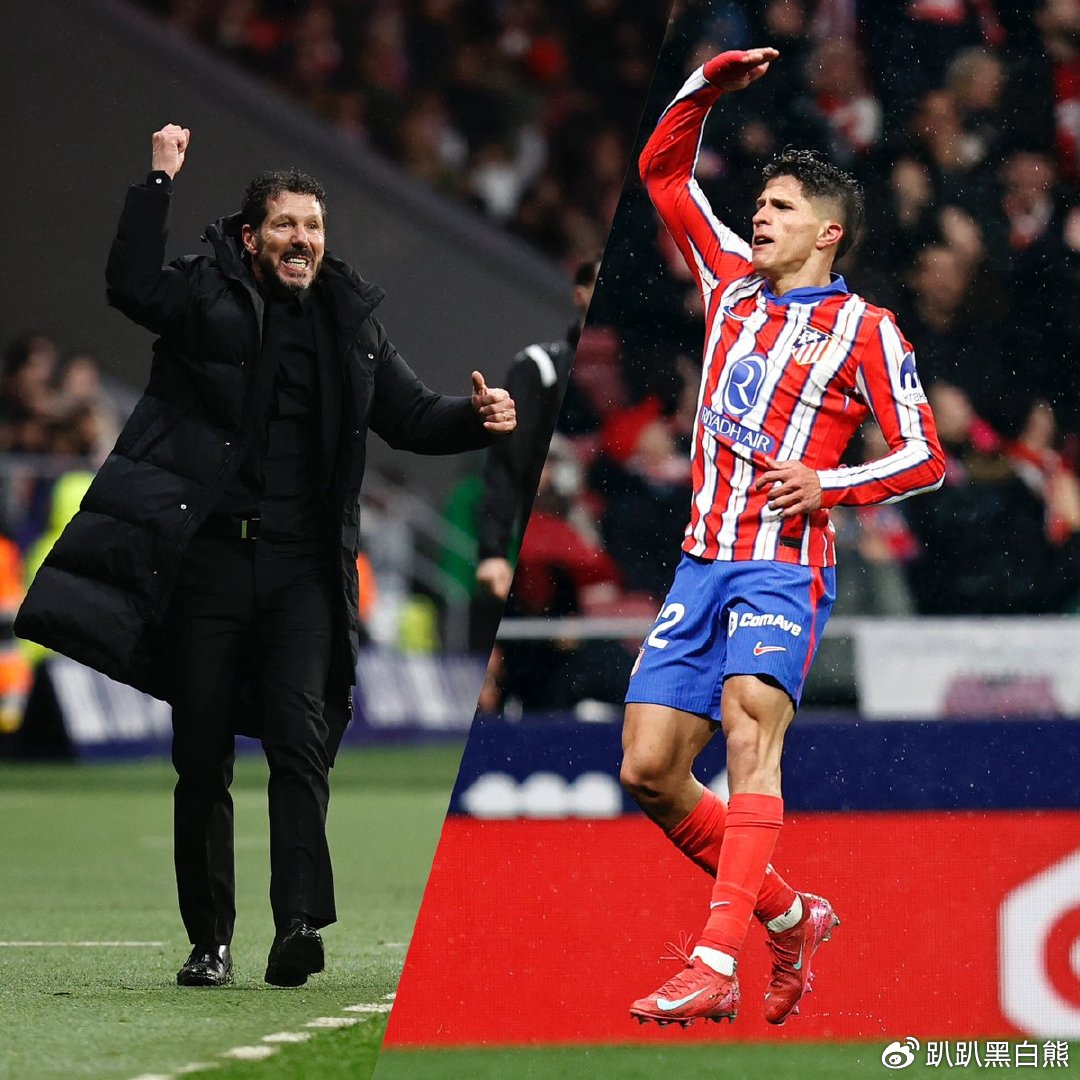
Cholito, Barrios, DePaul and Gallagher in the midfield, Llorente and Garland on both sides of the formation, and the two stars Álvarez and Griezmann, formed a style of play with excellent physical fitness, no fear of confrontation, and the ability to press forward with fast pace and high intensity throughout the field. Compared with the control and stability in the first stage, this highly recognizable system in the second stage was born for impact, pressure, and counterattack.
The player's lack of dribbling ability is a shortcoming in the offense. Lino and Riquelme, who have certain skills but are not capable, are also substitutes all year round. However, first Garland worked hard, and then Cholito carried forward. Although the Atlético players did not have extraordinary 1v1 skills, they led the way forward through extremely aggressive and oppressive fighting, and created space for Griezmann, Álvarez and Sørloth.
Although Garland failed to impress Simeone at first, as the former La Liga steals king, he is indeed the confrontation point Simeone is looking for. In the 10th round against Leganes, Garland brought a long-lost and strong aggression to the team on the wing. He rushed to the bottom line, created opportunities, and could also take care of returning to defense. Before Cholito became the starter, he was the only player on the team who fought for every ball, and his hard work also brought motivation to his confused teammates, thereby achieving results despite the imperfect system.
In addition, the adjustment of the Atlético midfielder is also very interesting. Gallagher is moved to the left to provide side confrontation, and the Koke, which lacks confrontation, is removed from the double midfielder composed of Barrios and DePaul. This is not a typical "destructive + organizational" combination of 4-4-2. The two people with similar types assume their own roles and have no conflict in responsibilities: when Koke is not on the court, Barrios takes on more organizational tasks, while DePaul on the right will have greater freedom. He can penetrate forward and send passes to create threats; and when Koke is on the court, Barrios can freely penetrate forward. Since then, Atlético no longer has a purely defensive midfielder that slows down the pace. This combination breaks the previous dogma. When the players have enough tacit understanding and can coordinate the space with each other, they can naturally bring greater threats.
The chaos caused by Cholito and Llorente's repeated pulling on the right, right midfielder DePaul also benefited from it. With teammates in front of him who are constantly cutting and running, he has a lot of space and time to make decisions. DePaul's organizational skills may not be the strongest, but his final pass is of high quality. After all, when he landed in Europe, he first played as an attacking midfielder in Valencia, then moved to Udinese and then retreated. His physical condition and running ability allow him to play a key role in pressing, fighting, dribbling and even finishing when he is in a good mood. And his coquettish energy to compete for every ball when he is in a good mood is the best embodiment of Argentina's national character. Because of this, DePaul's "awakening" and system bonuses are obvious, but the most important thing is his change in mentality. This season, he can change from "playing based on his mood" to "playing every game as if he were playing in the World Cup finals with Messi", which is impressive.
In contrast, the midfield of Atlético in the 23/24 season was slow, and Morata + Grizi was positioned behind, which made it difficult for Atlético to organize an effective counterattack. Now after the change of thinking, Atlético not only moves forward as a whole, but also turns into a counterattack blade for everyone in the frontcourt. Especially when the opponent reorganizes the attack, they can counterattack directly on the spot, which is something Atlético could not do before.
The Grizi in the second stage is simply exquisite, and it is worth taking a closer look at each game. In addition to the heavy series organization tasks, how he lurks in the offside position for multiple rounds to observe when the opportunity and space are really opened for him; when the team's impact wide players frequently make passes to create space, how he accurately appears in the middle, meets the ball, and uses silky feet to send the ball into the dead corner. He's not a power forward, but The accuracy, timing and feel of his handling of the ball make him break away from modern temperament and reflect the style of an old artist。
But Atlético still needs a superstar and a hero. That is Julián·Álvarez.
He came here just to create victory out of thin air and rewrite the impossible score. Bayer Leverkusen's consecration battle, his drive, passion, courage and firm will make people burst into tears. And this is also the iconic battle in which Atlético qualified for the championship based on its performance.
All these changes also bring another important effect: the Atlético bench now has players who can change the game. This Atlético lineup has a wide range of frontcourt personnel. They can substitute for the decisive victory according to the situation in the second half, or switch to paddling mode in advance. Simeone has perfected the management of the game. It can always reshape the rhythm of the game through substitutions, let the game be played in a way that adapts to local conditions, and win the game that should be won.
This system makes the most of the cards in hand. The biggest weakness is the lack of a left-footed central defender with excellent mobility, qualified confrontation, and the courage to attack to form a four-back defense. The key to the defense is not whether it can be defended, but whether the Atlético central defender presses forward or retreats when the opponent counterattacks. Among the current central defenders, Jimenez and Lenglet are more suitable for low defense, but once they retreat, it is easy for loopholes to appear between Lenglet and Garland. Only when Lenormand, who is in good condition, is on the court, can the Atlético back line possibly stand firm in the mid-to-high position.
There is a contradiction here. When Lenormand was injured and retired, the central defender combination of Gimenez and Lenglet was more suitable to retreat, but the midfielder and frontcourt personnel were more suitable to press forward. This set of contradictions made the second-stage system flawed and would be penetrated by the opponent's sprint point, such as the thrilling comeback against Sevilla in December, the goal lost in the game against Bratislava, and even the inability to deal with the top wingers of Real MadridBarcelona.
Although it is not perfect, Simeone has not stuck to the same system for a long time. This shows that he has found a direction and he believes in this direction. But he was still very anxious. After all, he kept hitting the abdominal drum relay, and sooner or later he would not be able to regain his HP. Atlético constantly adjusts the starting lineup, substitutions, and formation changes during the game. It is precisely because of the concern that the main lineup under high-intensity play will sooner or later suffer from physical exhaustion.
The third stage: inertia exhausted, fatigue evident
Whether Atlético can maintain this system in a continuous strong dialogue and how to deal with physical exhaustion has become the cause of the third stage of Atlético.
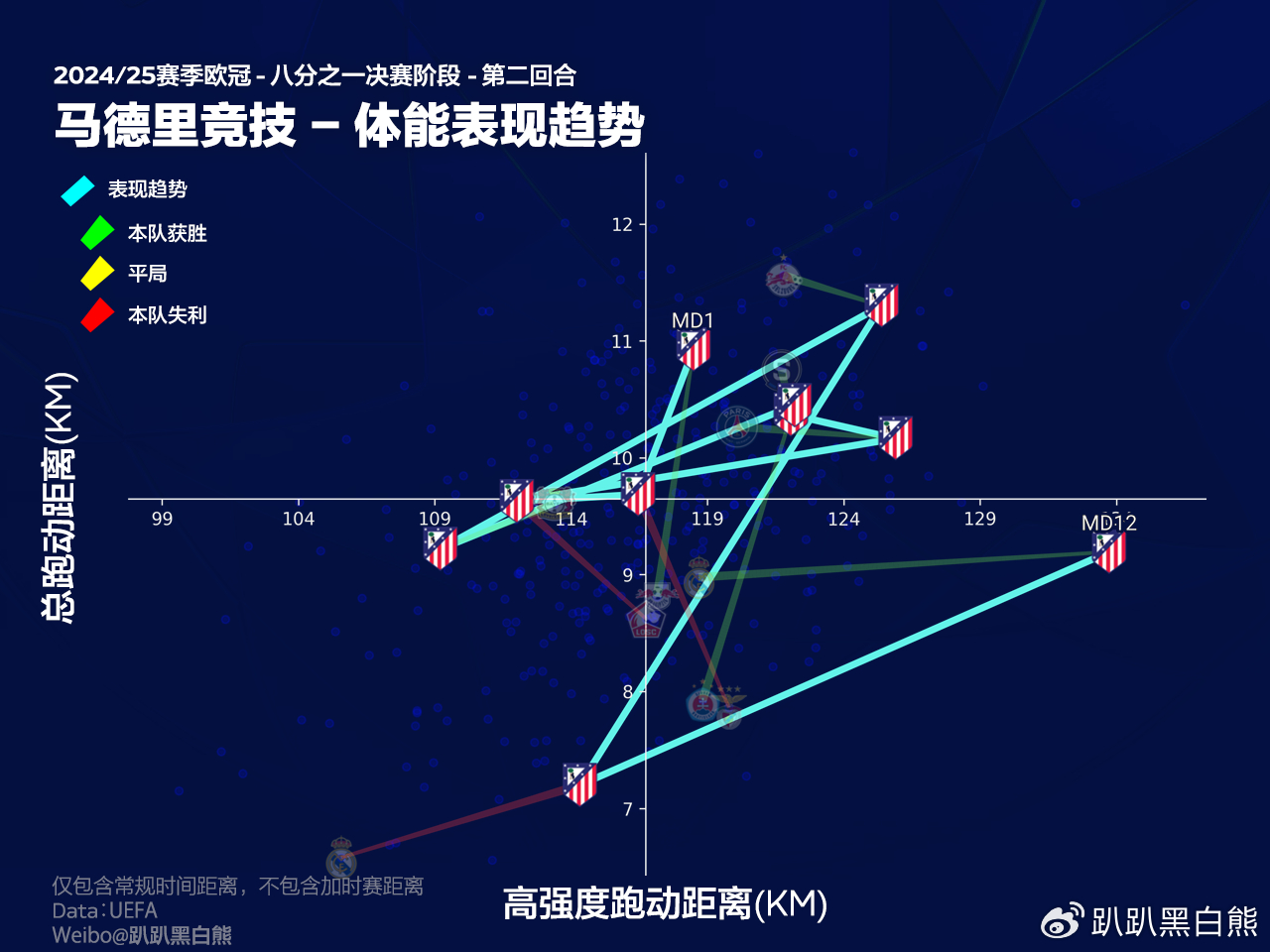
Atlético’s running and running intensity are at a higher level among the Champions League team, and the second round (MD12) of Champions LeagueReal Madrid was a bloody battle
After ultra-high-intensity continuous battles, Atlético was physically and mentally exhausted after the penalty shootout with Real Madrid. The consequence of fatigue was that they were reversed by Barcelona 2-4 at home. But before these two games, the 1-1 against Celta Vigo could already see the weakness of the opponent's attack. At that time, the team's momentum was already fading.
Between the second and third stages, as the tactical inertia of "Cholito widening +4-4-2" was exhausted, Atlético urgently needed Griezmann to participate in the organization and clarify the ball path. After all, Atlético's current wing players generally need clear timing and path guidance in offense. They have become accustomed to the "creation" method of "pass now" and "go this way" that chews up the advantages that are given to them.
But the problem is that veteran Griezmann is already 34 years old. This season, Atlético's third-line battle in March consumed far more than last season, which also made the decline of Grizi more obvious.
At the same time, Grizi's position as a forward this season is higher than last season, and he needs wide players to open up vertical space for him. This further forces Atlético to only squeeze the wings. Molina, Lino, Gallagher, Garland, Reinildo, Cholito... one after another, they consume themselves on the wings to the point of being unsustainable, and Griezmann is also trapped. To make matters worse, the five-game suspension of La Liga by "General of the West" Correa not only deprived Atlético of the core figure of tactical changes, making it difficult to harvest the game, but also further increased the load on Griezmann.
Although the form is different, the team has returned to a state of difficulty in advancing. Today, only players such as Álvarez, Cholito, Llorente, and Garland who are self-sufficient and rely less on the bonuses of the tactical system are not affected. The team can still rely on their impact to play in depth, even if it is rough. However, once the energy of these players is not enough to support the task of leading the line, there is a possibility of a complete collapse.
After losing to Las Palmas, Simeone was slightly helpless: "I'm not thinking about La Liga, I'm thinking about many things now."No one wants to bring Atlético to the top more than Simeone, but it is not difficult to understand his fatigue. This is not only a decline, but these problems recur every season and have become deep-rooted, and the personnel configuration exceeds the coach's ability and scope of responsibilities.
In the last few games, if there is anything to look forward to, it is to see whether Álvarez can reduce the burden on Grizi, or even take over the banner of Grizi early. In the past few seasons, Griezmann has always been the irreplaceable center of the Atlético offensive and defensive system, responsible for almost all transitions from defense to offense and even finishing tasks. The arrival of Álvarez is the club’s response to the dilemma. The status of Grizi+Little Spider is enough to determine the upper limit of Atlético.