
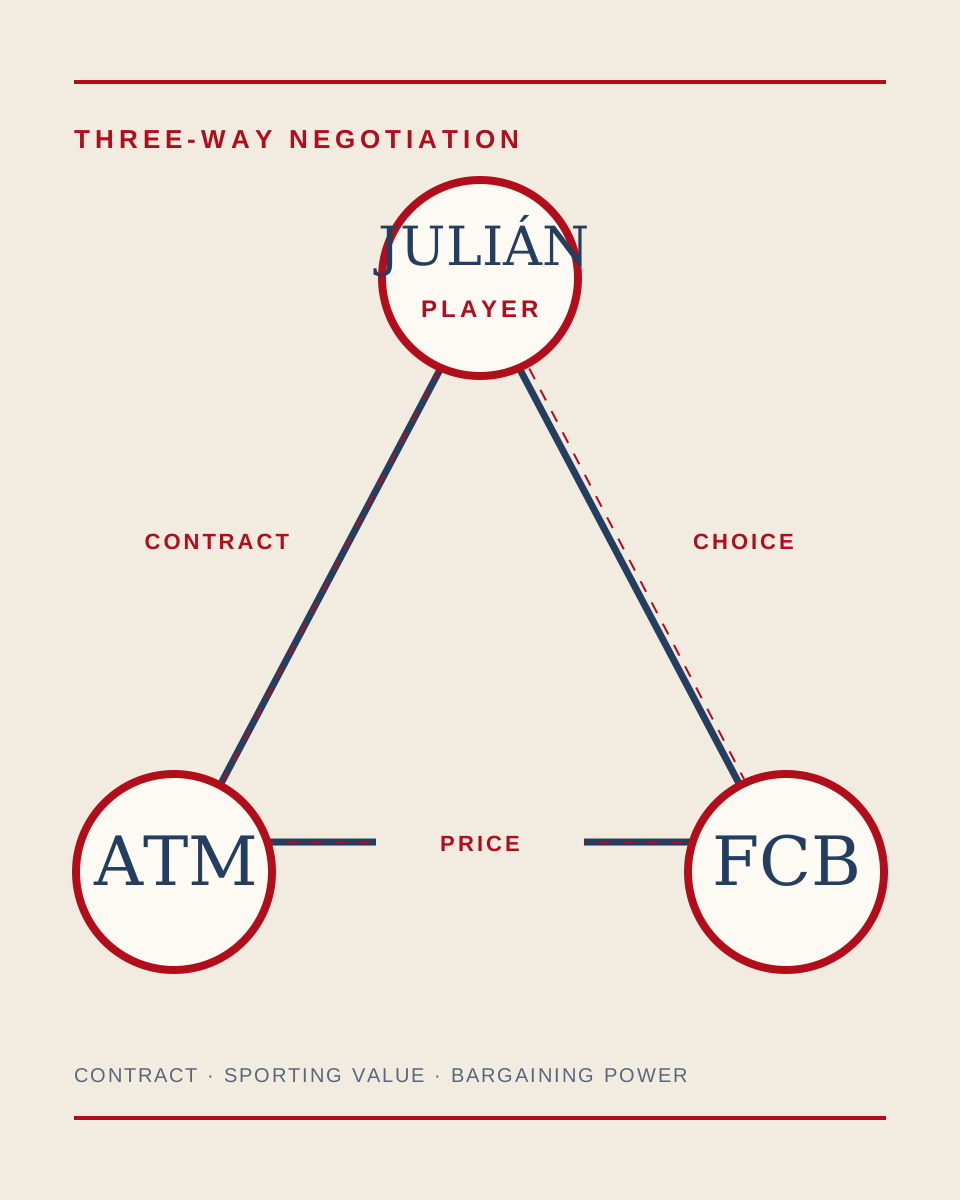
Today (May 29), events developed rapidly, far beyond the snacking capacity of a pack of sunflower seeds. However, compared to discussing which news is true or false, it is more worth paying attention to what this deal means for Atlético, Álvarez, and Barcelona respectively.
Atlético de Madrid
Let's talk about Atlético first. Although Barcelona has a lot of momentum in the media, Atlético holds the initiative in this deal. Their confidence comes from the fact that Atlético has Álvarez's contract signed until 2030, so there is no pressure from an expiring contract. Additionally, from an economic perspective, ten years ago Atlético was frequently forced to sell their star strikers because the club's financial situation at the time was more precarious, limiting their bargaining power. But now, with Apollo Capital's investment and the overall improvement in the club's revenue capacity, Atlético no longer needs to sell players to balance the books. Atlético doesn't have to sell Álvarez, but if the player has already lost his sense of identification, actively selling him is a more reasonable option. These two plans are not inherently conflicting.
Therefore, Atlético will definitely maintain a tough stance in negotiations, leveraging the contract advantage and sticking to their position: Álvarez can be sold, but it must be under the conditions set by Atlético.
For Atlético, as long as the final transaction price meets their expectations, it is considered a victory. If in the end they are forced to accept a proposal below expectations due to player pressure, public opinion, or time pressure, it is a failure.
Atlético's tough response in the media is also a way to manage market expectations, because once the whole market forms the perception that players will leave, the club's bargaining power will shrink. Moreover, the issue is not just about cash flow; for any club hoping to enter the ranks of Europe's top teams in the long term, whether core players see the club as a long-term project rather than a temporary stepping stone is itself a part of brand building.
From a competitive perspective, Álvarez, as a primary-level investment, has not delivered enough so far. If you ask who will be Atlético’s core in the 2025-26 season, people would first think of Lukman and Griezmann, not Álvarez. Friends who have followed and watched Atlético’s matches this season know clearly that sporadic flashes in the Champions League cannot cover up his slump in La Liga. Atlético currently ranks fourth in La Liga this season, largely due to Álvarez’s scoring drought in open play for four consecutive months after the 5-2 Madrid Derby. When teammates frequently cross the ball, Álvarez doesn’t enter the penalty area but stands at the top of the arcs or at the second point, leaving only Sørloth inside the box. If the Spider does not enter the penalty area and his backtracking organizational ability is insufficient to bear the responsibility of a key playmaker, then his positioning and performance naturally become very awkward.
Because Álvarez displayed selfless sacrifice and extensive running coverage on the field, people tend to be more forgiving. Simeone even took the initiative at a press conference to cover for him, citing a newborn at home as an excuse. Within Atlético, no one has ever doubted him and they have given him absolute trust. But ironically, the trust he received has been met with constant leaks from his agent team and Argentine media, criticizing Atlético's tactics as 'not offensive enough,' using the same old narrative. Now that off-field rumors have erupted, people have begun to reexamine that period of several months of slump during the season. At least in terms of the outcome, it is difficult to completely separate the two.
After Griezmann left the team, Atlético was already facing the practical need to reorganize their system. At this time, Álvarez was considering leaving, and the most reasonable outcome would be for Barcelona and Atlético to reach an agreement on Álvarez. At the same time, from a sporting and market perspective, Ferran is a very good opportunity. For Atlético, more than 135 million in cash, or a deal with over 100 million in cash plus Ferran, are both worth discussing.
But the question is, what message does this deal ultimately send to the outside world? Football clubs are not ordinary companies; they always have to sell hope. Two years ago, Atlético signed Álvarez, which was an extremely rare market opportunity. Atlético desperately needs a star of Álvarez's caliber to attract other outstanding players. If Álvarez leaves, who Atlético should sign as the team's core will be a matter that requires careful consideration.
Álvarez
From Álvarez's perspective, after considering all public information, I judge that he now clearly wants to go to Barcelona. Often, when someone indirectly states or explicitly says they want to leave, they are already halfway gone. Even if you still want to keep them emotionally, no matter how reluctant you are, you must rationally admit that forcibly holding onto someone whose goals and project direction are already inconsistently risky. If they give up in the future, the toxicity will only grow. For Simeone, who places great importance on dressing room management, such risks are unacceptable—Samu is a precedent. Therefore, at this point, there is no turning back for Álvarez and Atlético
So, the party that is truly anxious right now is Álvarez. The only option he currently has is the choice to want to leave the team. What Atlético should do is hold firm on their bottom line, make Álvarez and his team anxious, and then use the contract advantage to squeeze the maximum benefits from the buyer.
But there is a scenario that could put Atlético in a passive position: if PSG/Arsenal make a formal offer significantly higher than Barcelona's, but Álvarez, according to his preference, rejects all offers except Barcelona's. At that point, the problem will shift from "how to sell Álvarez" to "how to sell an Álvarez who only wants to join Barcelona." This would directly weaken Atlético's bargaining power.
Álvarez's turmoil does resemble Aguero 2.0, but the difference is that Álvarez has now achieved a career Grand Slam, and his mindset is much more mature than Aguero's during his Atlético days. No matter how anxious he is, at least on the surface he still maintains a sense of measured action.
Of course, we should not completely deny Julián's contributions over the past two years. Álvarez is far from being a disaster-level investment like Félix. Over the past two seasons, whether in the Champions League or in key matches, he has had quite a few standout moments. But he is still far from being an Atlético leader willing to build the team together with the club. This is no longer just a matter of physical condition and skills; at the slightest setback, he thinks about leaving. In this regard, Grizi, before going to Barcelona, endured for several years and accompanied Atlético through a complete rebuilding cycle.
Barcelona
From Barcelona's perspective, this deal actually addresses the issue of team building. Any club has the right to make an offer, and any player has a price; this is just how the market operates. Based on historical experience, over the past twenty years, Barcelona has also been adept at leveraging the media, player willingness, and public opinion to drive deals. From Fàbregas to Coutinho, this model has long become the club's most familiar way of operating. While this may irritate peers, it is extremely pragmatic commercially.
After experiencing the post-pandemic era of leverage, Barcelona has finally returned to the 1:1 rule this year, which means their financial health has significantly improved. The bottleneck for registering players is no longer whether they can pay the transfer fee, but the salary cap space. Additionally, Barcelona's offers usually do not keep increasing; they generally make an initial offer, and if it can be negotiated, they sign the deal, if not, they move on. Once they start raising the offer in a deal, it proves that this is a Plan A target.
At the same time, Barcelona is also in a rebuilding window, advancing key targets such as Gordon. In terms of characteristics, Gordon is clearly someone Flick specifically wants. However, with Lewandowski leaving and Rafinha likely to stay, Barcelona's focus remains on the striker, or rather on deciding the front-line structure for the next five years for Amial, who is entering a period of competing for the Ballon d'Or. Amial's strongest abilities are creating with the ball, drawing double teams, and delivering the final pass. Therefore, the striker paired with him needs to be capable of finishing, maintaining high-pressing, constantly providing off-ball runs, and handling front-line rotations. Álvarez happens to be one of the few forwards in the current environment who can simultaneously meet these requirements.
If Barcelona has already defined Álvarez as the most suitable partner of the Xavi era internally, then the potential development space of this deal may be greater. The question is, if Gordon takes up a large amount of funds and wage space, can Barcelona still meet Atlético's price demands?
If Barcelona completes this deal at a cost close to a historical record, then even if Álvarez still plays a supporting role, the expectations from the outside world will be completely different. At that time, whether it is the club, the media, or the fans, the standards for evaluating him will match this top-level investment. For any record-breaking signing, this is an unavoidable test.